

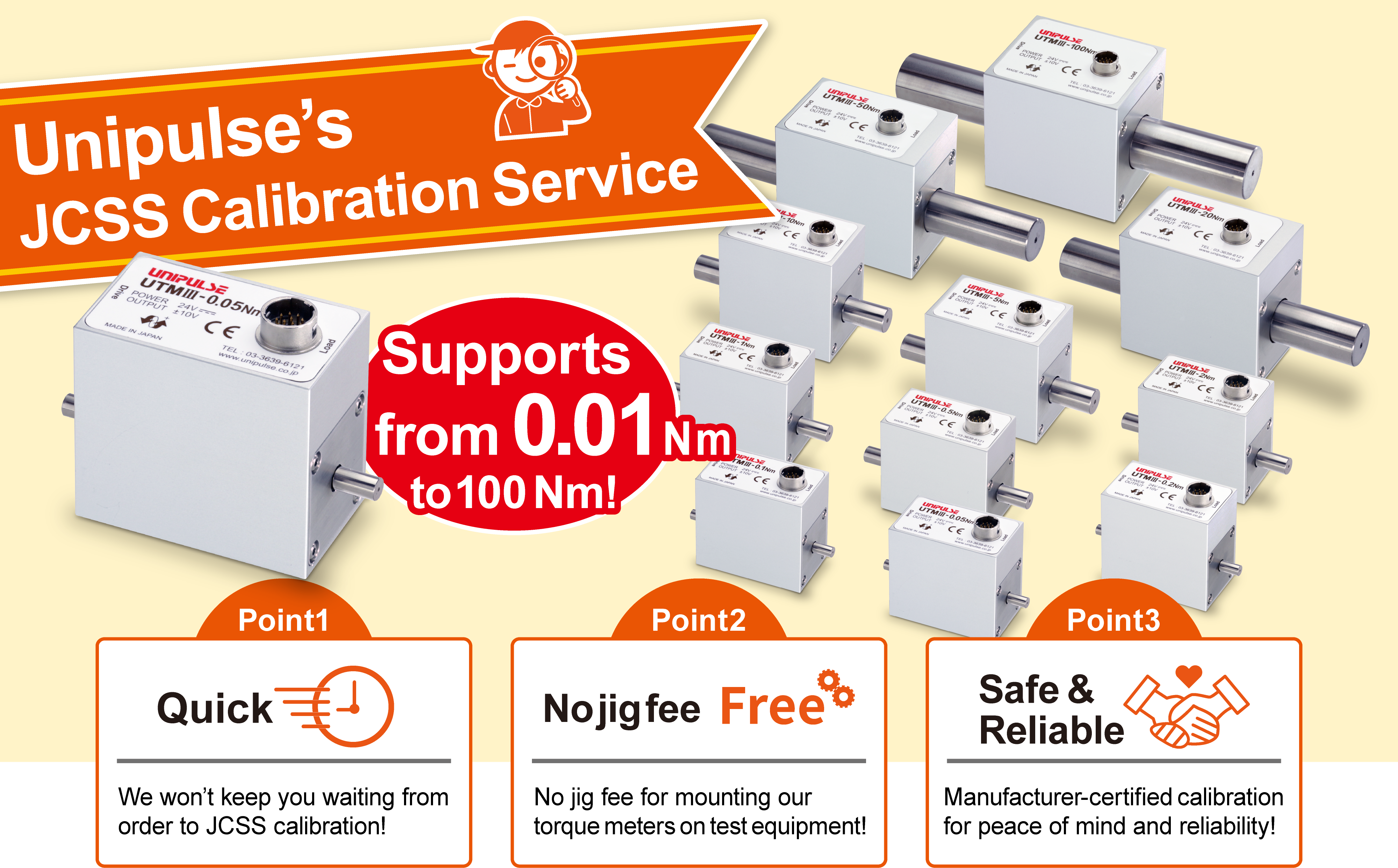
Unipulse is a certified provider of JCSS calibration (registered category: torque).
Benefits of JCSS calibration
● Increased reliability of calibration results
● Documentation regarding traceability to national standards is not required.
● Proof of uncertainty that is required to ensure traceability
For example, IATF 16949 (Automotive Industry Quality Management System) requires that inspections, tests,
or calibration services provided by internal testing laboratories, external testing laboratories, and measuring instrument manufacturers meet the requirements of ISO/IEC 17025.
Sample certificate and applicable products
Sample calibration certificate
Samples of the certificate issued when requesting JCSS calibration can be viewed below.
Please see below for products that can be calibrated using JCSS.
Additionally, the applicable products will be updated sequentially.
Please contact us regarding any products that are not listed.
How to apply for JCSS calibration
Please check “About JCSS Calibration of Torque Meters” and contact our sales representative or distribution partners.
〇 I want to purchase a JCSS calibrated torque meter.
Please inform our sales representative accordingly.
Please specify whether calibration will be performed on the torque meter alone or in combination with an indicating instrument.
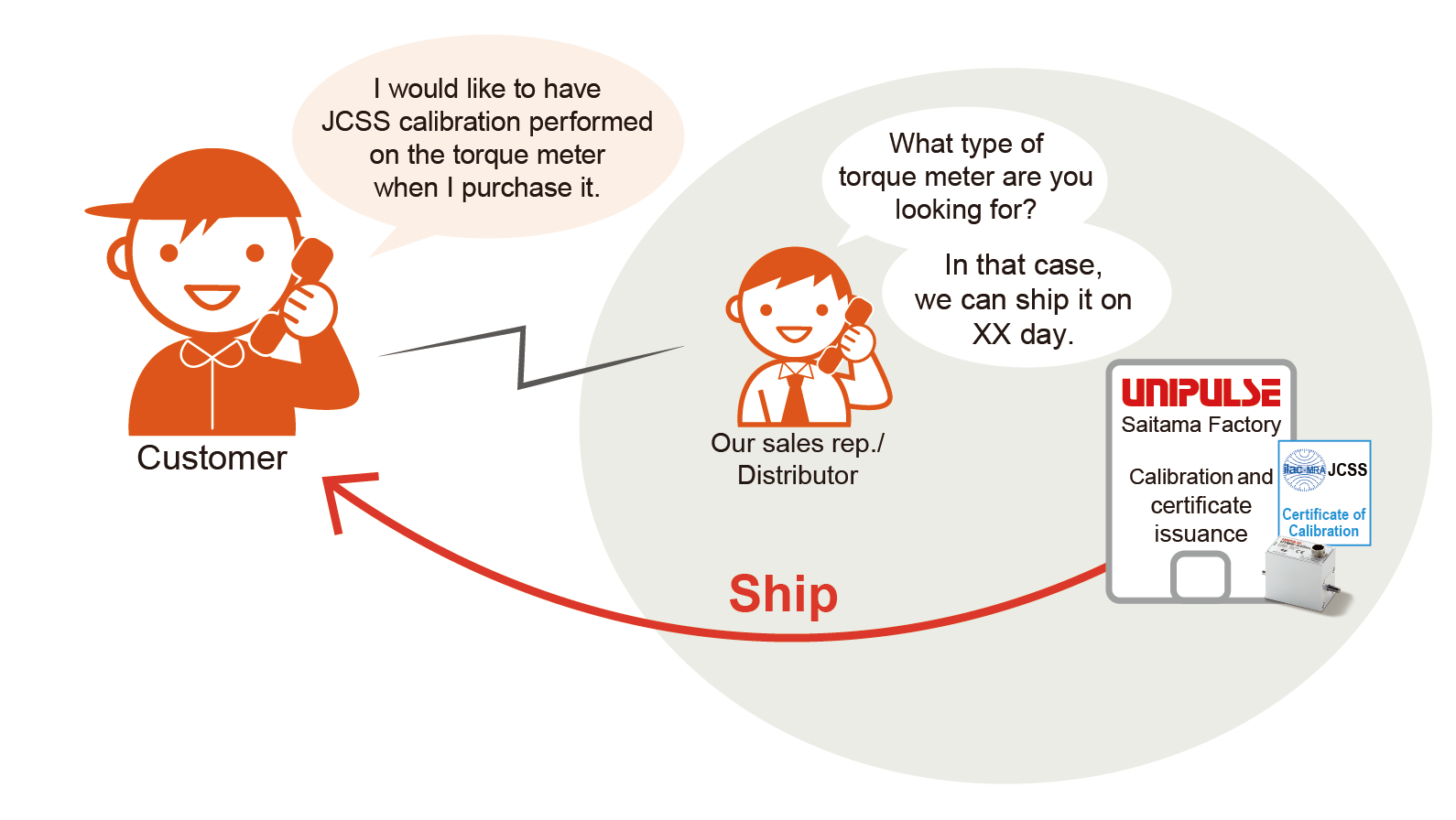
〇 I would like to have a torque meter JCSS calibrated after I’ve purchased it.
Please inform our sales representative or distribution partners of the model type, whether combination calibration standards are required, and the expected date for shipping the torque meter to us.
We will notify you whether calibration is possible and the expected shipping date for return. After checking that there are no problems, please send the torque meter to our distribution partners, or to the address below.
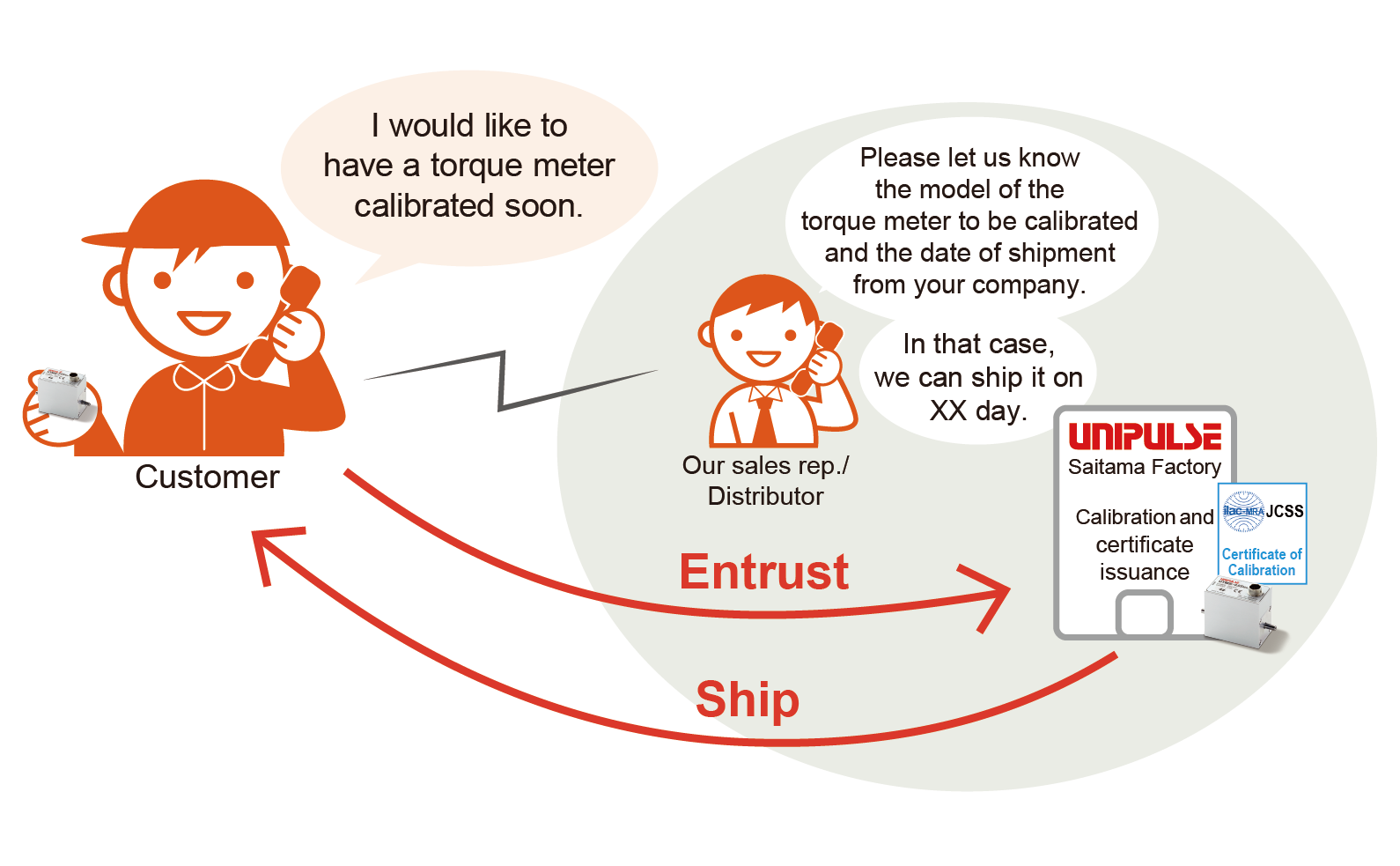
(In case of sending directly to manufacturer)
Unipulse Corporation Saitama Factory
1-3 Sengendainishi, Koshigaya, Saitama 343-0041 JAPAN
Contact at: Unipulse International Sales Department
sales@unipulse.co.jp
*Please specify the item, model for which you are requesting JCSS calibration.
Frequently Asked Questions (FAQ)
- Can you calibrate products from other manufacturers?
- We may be able to calibrate them, so please contact our sales department.
- How long does it take from requesting JCSS calibration until the calibrated torque meter is returned?
- The standard calibration period is 10 business days. However, the period may change depending on the number of requests and the acceptance status.
Key groove and square drive types may require additional time.
- I can’t remove the torque meter, so I would like it calibrated on-site.
- Our JCSS calibration is performed using our in-house equipment, so we will take custody of your torque meter and perform the calibration work at our facility.
- How often should JCSS calibration be performed?
- The frequency of calibration must be determined by the customer themselves, depending on the operating environment and condition of the torque meter.
- What is the difference between JCSS calibration and manufacturer calibration?
- JCSS calibration is performed by a calibration service that is accredited by a third party, based on the requirements of ISO/IEC 17025. In contrast, manufacturer calibration involves using a device that the manufacturer has determined as the standard to maintain traceability. Additionally, while JCSS calibration includes uncertainty in the certificate, our manufacturer calibration does not include uncertainty.
- After purchasing a torque meter, I found out that it needed JCSS calibration.
- We will undertake JCSS calibration even if the torque meter has already been delivered. Please send your torque meter to us or distribution partners for JCSS calibration.
- I lost my JCSS calibration certificate. Can it be reissued?
- Calibration certificates can be reissued upon request.
- How many calibration points are there?
- Calculations are based on measurement data for both right and left twisting at 8 points up to the rated capacity (5 points each for 0.05 N m each).
Specifically, measurements are taken at 10, 20, 30, 40, 50, 60, 80, and 100% of the rated capacity in 10% increments.
However, for the rated capacity of 20 N m only, measurements are taken at 12.5, 25, 37.5, 50, 62.5, 75, 87.5 and 100% in increments of 12.5%. (Actual load type only)
If you would like to measure at other points, please contact our sales representative or distribution partners.
- What should I be careful of when sending my purchased product?
- Please be sure to remove any jigs etc. before sending it.
Please do not send any items other than the product to be calibrated, such as removed jigs.
We cannot be held responsible for any loss or damage to items other than the product being calibrated.
Thank you for your understanding in advance.
- What is the difference between the actual load type and the build-up type?
- The difference between the actual load type and the build-up type is how the torque is achieved.
The actual load type achieves torque from the mass of the weight, the length of the arm, and the acceleration due to gravity. Compared to the build-up type, there is less uncertainty.
The build-up type achieves torque at the same torque as that indicated by the reference standard torque meter. This calibration is performed by comparing the standard torque meter with the torque meter being calibrated. Compared to the actual load type, there is more uncertainty.
What is JCSS calibration?
The Japan Calibration Service System (JCSS) is a system for the calibration of measuring instruments and other devices, aimed at providing measurement standards traceable to national standards. It consists of the “National Standards Provision System” and the “Calibration Laboratory Accreditation System.”
〇 National Standards Provision System
This system involves calibration organizations—designated by the National Institute of Advanced Industrial Science and Technology, the Japan Electric Meters Inspection Institute, or the Minister of Economy, Trade and Industry—performing calibration and other services on registered businesses standard instruments using specified standard instruments, and providing measurement standards.
Japan’s national standards are defined as specific standard instruments and specific reference materials under the Measurement Act.
〇 Calibration Laboratory Accreditation System
As a calibration service provider, it is recognized by the government as having reliable calibration technology and facilities that connect national standards with measuring instruments (meeting the requirements of the Measurement Act and related regulations as well as ISO/IEC 17025).
About symbols
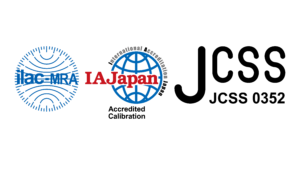
If you request JCSS calibration for an applicable product, we will issue a calibration certificate bearing the JCSS certification symbol with ILAC-MRA. The JCSS certification symbol indicates that the calibration service provider is registered under the calibration service registration system based on the Measurement Act, while the ILAC-MRA symbol indicates that the calibration service provider is an international MRA-compliant accredited calibration service provider.
International MRA (Mutual Recognition Agreement)
The accredited bodies of countries that have signed the International MRA mutually recognize the equivalence of their certification processes for calibration service providers.
Therefore, calibration certificates bearing the ILAC-MRA symbol are highly reliable even in international transactions and may eliminate the need for additional calibration or testing in other countries.

Terminology
| ILAC | International Laboratory Accreditation Association |
| IA Japan | International Accreditation Japan (IAJapan), National Institute of Technology and Evaluation |
| Traceability | A calibration chain seamlessly linked to national standards |
| ISO/IEC17025 | General requirements for the competence of testing laboratories and calibration laboratories |
| Uncertainty | Measurement uncertainty refers to the range of doubt that exists regarding a measurement result. |
